Beyond budgeting: how enterprise performance management is redefining the way organizations think about the future
The annual budget is obsolete before it is approved. Enterprise performance management replaces the ritual with continuous planning, integrated financial and operational data, and rolling forecasts that connect strategy to execution.
By OneVision Consulting
Share on LinkedIn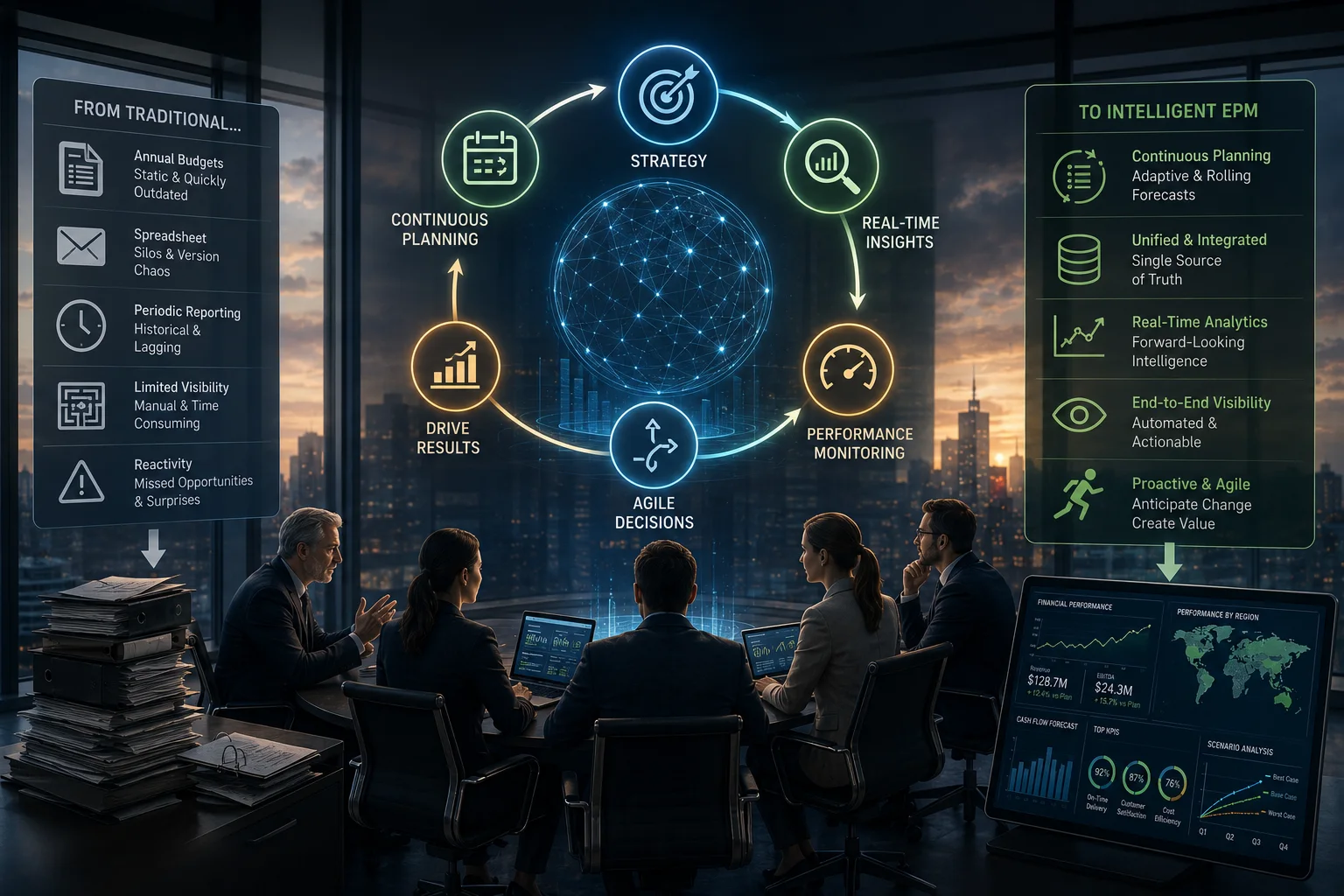
On this page
01The budget that was obsolete before it was approved
It is October, and finance teams across the corporate world are deep in the annual budgeting ritual. Spreadsheets proliferate. Assumptions are debated. Negotiations consume weeks of executive time. By December the budget is finalized, approved by the board, and distributed to business units.
By February it is obsolete.
Market conditions have shifted. Competitors have made unexpected moves. Customer preferences have evolved. The carefully constructed budget — representing thousands of hours of work — no longer reflects reality. Yet organizations continue to manage against it, making decisions based on assumptions that are demonstrably wrong.
This is the paradox of traditional financial planning. Organizations invest enormous effort in creating plans that are outdated almost immediately, then compound the error by treating those plans as immutable truth rather than dynamic hypotheses to be continuously refined.
Enterprise performance management is a fundamental rethinking of how organizations plan, monitor, and optimize performance. It moves past the limits of spreadsheet-based budgeting to create integrated, dynamic systems that connect strategy to execution, enable continuous planning, and provide real-time intelligence for decision-making. What follows is the evolution of EPM, where its strategic value actually comes from, and how leading enterprises are using it to compete in an era of sustained uncertainty.
02The evolution of EPM: from budgeting tool to strategic asset
The limits of traditional financial planning
Traditional financial planning evolved in an era of relative stability. Annual budgets made sense when business conditions changed slowly and predictably. Spreadsheet-based planning was adequate when planning was primarily a finance activity with limited cross-functional integration.
That era is over.
The spreadsheet problem
Spreadsheet-based planning carries structural limitations that become more damaging as an organization grows in complexity.
- Version control chaos
- Multiple versions circulate by email. Which one is current? Who changed what? Consolidating inputs from dozens of business units becomes an exercise in forensics.
- Limited collaboration
- Spreadsheets are single-user tools. Collaboration means emailing files back and forth, which creates version proliferation and makes real-time work impossible.
- Error exposure
- Manual data entry, formula errors, and broken links create data quality issues that quietly undermine confidence in the output.
- No audit trail
- Understanding how a number was derived, who changed it, and why is difficult or impossible after the fact.
- Scalability limits
- Consolidating hundreds of cost centers across multiple geographies in spreadsheets is a monthly ordeal that grows with the business.
- Thin analytics
- Spreadsheets calculate. They do not provide the scenario modeling, driver analysis, or predictive capability that strategic planning requires.
EPM systems offer dynamic, real-time financial modeling and holistic performance management, integrating financial and non-financial data. They align financial planning with long-term organizational goals, enhancing strategic decision-making capabilities.
Five generations of EPM
- 01Budgeting and planning — automating the annual budget with workflow, consolidation, and basic reporting. Spreadsheets were replaced; the annual cycle was not.
- 02Integrated financial planning — connecting revenue forecasts to capacity, workforce, and capital planning.
- 03Strategic performance management — linking financial plans to strategic objectives through frameworks such as the balanced scorecard and strategy maps.
- 04Continuous planning and predictive analytics — rolling forecasts, real-time analytics, and forecasting models that learn from history.
- 05Intelligent EPM — AI and machine learning providing autonomous insight, predictive recommendations, and intelligent automation.
Most organizations are somewhere between the second and third generation, running modern software against an annual planning calendar. The software is rarely the constraint. The calendar is.
03What EPM is and why it matters
Enterprise performance management encompasses the methodologies, metrics, processes, and systems used to monitor and manage organizational performance against strategic objectives. It integrates financial and operational planning, budgeting, forecasting, consolidation, reporting, and analytics into a single framework that connects strategy to execution.
The core capabilities
- Strategic planning
- Defining strategy, setting objectives, and cascading goals through the organization. EPM provides the structure for translating a vision into plans someone can act on.
- Budgeting and planning
- Allocating resources to strategic priorities through collaborative, driver-based planning that links operational assumptions to financial outcomes.
- Forecasting
- Continuously updating projections as actuals arrive and conditions change. Rolling forecasts replace the static annual target with a forward view that is always current.
- Consolidation and close
- Aggregating results across entities, eliminating intercompany transactions, and producing consolidated statements faster and with fewer manual steps.
- Reporting and analytics
- Dashboards, scorecards, and self-service analysis that put timely, accurate performance information in front of the people making decisions.
- Performance monitoring
- Tracking actuals against plan and objectives, surfacing variances early, and triggering corrective action while it still matters.
Where the strategic value comes from
- Strategic alignment — EPM closes the gap between high-level strategy and operational execution, keeping activity pointed at objectives and keeping objectives grounded in operational reality.
- Better decisions — integrating financial and operational data gives leaders the full context: strategic intent, financial constraint, and operational capability in one view.
- Organizational agility — continuous planning and real-time analytics let an organization adjust course in weeks rather than waiting for the next annual cycle.
- Resource optimization — visibility into where money and effort are going makes it possible to move both toward the highest-value activities.
- Transparency and accountability — when performance is visible and ownership is explicit, accountability follows without being manufactured.
- Competitive advantage — deciding faster, allocating better, and adapting sooner compounds over time in a way competitors find difficult to copy.
EPM systems are strategic assets driving business success in a dynamic, competitive global marketplace, leveraging predictive analytics and machine learning for improved forecasting and decision-making.
04Connecting strategy to execution
One of the most persistent problems in management is connecting strategy to execution. Organizations develop sophisticated strategies and then struggle to translate them into operational reality. Strategic plans sit on a shelf while day-to-day operations proceed disconnected from strategic intent.
Research suggests that 60 to 90 percent of organizations fail to execute their strategies successfully. The reasons vary — unclear objectives, misaligned incentives, inadequate resources, poor communication, no accountability — but they share a shape: nothing carries the strategy from the offsite into the operating rhythm. EPM is the mechanism that does.
The strategy-to-execution framework
- 01Strategic planning — define vision, mission, and objectives, and translate them into measurable targets across financial, customer, process, and learning perspectives.
- 02Goal cascading — turn enterprise goals into divisional, departmental, and individual objectives so that alignment is structural rather than aspirational.
- 03Resource allocation — allocate financial, human, and capital resources to those priorities through the planning process, so budgets and strategy describe the same intentions.
- 04Performance monitoring — track progress against objectives with a small set of indicators leadership actually reviews.
- 05Variance analysis — identify and explain the gaps between plan and actual, early enough to act on them.
- 06Corrective action — reallocate resources, adjust initiatives, or revise the plan when performance deviates. A framework that only reports is not management.
- 07Strategic learning — capture what the cycle taught and carry it into the next one, so planning capability improves rather than repeating.
Integrated financial and operational planning
Traditional planning treats financial and operational plans as separate artifacts. Finance builds a budget on high-level assumptions while operations plans activity on different ones. The disconnect is where misalignment and missed opportunity live. Integration takes four specific forms.
- Driver-based planning
- Rather than planning at the account level, link operational drivers — units sold, headcount, capacity utilization — to financial outcomes. The assumptions behind the numbers become visible and arguable, which is the point.
- Cross-functional collaboration
- Sales forecasts drive production plans, which drive procurement, which drives cash flow. One integrated plan reflects those dependencies instead of hiding them in four systems.
- Scenario modeling
- What happens if capacity expands? If a new market opens? If demand drops 20 percent? Modeling the financial consequence of operational choices is what turns planning into decision support.
- Rolling forecasts
- A forecast that projects 12 to 18 months forward and updates as results arrive gives a continuously current view of expected performance rather than a snapshot of last fall’s expectations.
05The building blocks: budgeting, forecasting, close, and analytics
Budgeting: from annual ritual to continuous process
Traditional annual budgeting consumes enormous effort for limited value. The process is painful, the output ages quickly, and the focus on annual targets rewards gaming and short-term thinking. Modern EPM changes the mechanics.
- Collaborative budgeting with workflow, approvals, and consolidation in one system — business units submit, finance reviews, executives approve, and nobody emails a workbook.
- Driver-based budgeting instead of line-item budgeting, which produces more defensible numbers and makes scenario analysis a matter of changing an assumption.
- Top-down targets and bottom-up plans reconciled iteratively, so executive ambition and operational reality meet somewhere honest.
- Zero-based budgeting where the organization wants it, with the tooling to justify expense from scratch rather than incrementing last year.
Forecasting: seeing around corners
In volatile conditions, forecast accuracy is a competitive capability rather than a finance nicety.
- Rolling forecasts
- Continuous projections 12 to 18 months out, refreshed monthly or quarterly as conditions change.
- Predictive analytics
- Models that find patterns in historical data, improve accuracy over judgment-only forecasting, and surface leading indicators earlier than a variance report would.
- Scenario planning
- Base, upside, and downside cases modeled together, so the range of outcomes is understood and contingencies exist before they are needed.
- Demand forecasting
- Seasonality, trend, promotional effects, and external factors incorporated into the demand signal that drives both operational and financial plans.
Consolidation and close: accelerating financial reporting
Consolidation — aggregating results across entities and producing consolidated statements — is traditionally slow and error-prone. It is also the most mechanical part of the finance calendar, which makes it the most improvable.
- Automated consolidation replaces manual spreadsheet aggregation and takes days out of the close cycle.
- Intercompany eliminations run automatically, so consolidated statements reflect only external activity.
- Currency translation is handled for multinational structures, with support for multiple translation methods.
- A complete audit trail of the consolidation supports internal controls and external audit without a reconstruction exercise.
- A fast close becomes achievable — consolidated statements within days of period end rather than weeks.
Reporting and analytics: from data to insight
- Dashboards
- Executive views of the metrics that matter, with drill-down for the question the number provokes.
- Scorecards
- Balanced scorecard and strategy map visualizations that show performance against objectives rather than against last year.
- Ad hoc analysis
- Self-service analytics so business users can answer their own questions without waiting on a reporting queue.
- Variance analysis
- Automated identification and explanation of the differences between plan and actual.
- Predictive analytics
- Analysis that identifies trends, projects outcomes, and points toward the action rather than stopping at the observation.
06The shift toward continuous planning
Why annual budgets are obsolete
- Obsolescence
- By approval, the assumptions have moved. The organization manages the year against a document describing a different one.
- Gaming
- Annual targets reward sandbagging, spending to budget before year end, and other behavior nobody would defend in the open.
- Inflexibility
- When conditions change, allocations that no longer make sense remain in force because reopening them is procedurally expensive.
- Time consumption
- Annual budgeting often absorbs four to six months of organizational effort, much of it negotiation rather than analysis.
- Short-term focus
- A twelve-month frame discourages investment whose payback lands outside it.
The continuous planning alternative
Organizations that have moved past the annual cycle tend to adopt the same five practices together, and the practices reinforce each other.
- Rolling forecasts project 12 to 18 months forward and are updated each quarter against actual results and current conditions.
- Detailed planning happens quarterly, so allocation decisions are made against this quarter’s information rather than last year’s assumptions.
- Resources are allocated dynamically to strategic priorities and live opportunities instead of being locked at the start of the year.
- Targets are set relative to market or competitive performance rather than to an absolute budget number, which encourages appropriate risk-taking.
- Compensation is decoupled from budget achievement, which removes most of the incentive to forecast politically.
The last one is where most programs stall. Rolling forecasts are a systems change; separating forecasts from compensation is a governance change, and it is the one that determines whether the forecast tells the truth.
Modern EPM systems enable continuous planning with rolling forecasts, real-time analytics, and AI-powered predictive capabilities. They revolutionize traditional EPM practices from reactive to predictive financial planning.
07AI-powered EPM: the intelligent future
Machine learning is moving EPM from a system that records and reports to one that predicts, recommends, and automates. Six applications account for most of the value being realized today.
- Predictive forecasting
- Models that analyze historical patterns and project outcomes more accurately than the statistical methods and manual judgment they supplement.
- Anomaly detection
- Algorithms that flag unusual patterns in financial data — error, fraud, or an emerging operational issue — while there is still time to investigate.
- Intelligent automation
- Data collection, consolidation, variance analysis, and report generation handled by the system, which is where the finance team’s time actually goes today.
- Natural language query
- Business users asking questions in plain language and receiving answers from planning data without an intermediary.
- Prescriptive analytics
- Systems that go past predicting an outcome to recommending the action that improves it.
- Scenario generation
- Automated construction and evaluation of scenarios across assumption sets that no team would have time to model by hand.
What the architecture requires
- Cloud platforms, for the computational capacity, elasticity, and integration surface that machine learning workloads assume.
- Comprehensive data integration across ERP, CRM, HR, and external sources — models are only as good as the data reaching them.
- Pre-built models for common cases such as demand forecasting, expense prediction, and anomaly detection, with room to develop custom ones.
- Real-time processing, so insight arrives with the event rather than in the following month’s pack.
- Explainable output. In finance, a recommendation that cannot be traced and defended cannot be used, whatever its accuracy.
What organizations report
- Forecast accuracy
- Improvements of 20 to 30 percent are commonly reported where machine learning has replaced judgment-only forecasting.
- Time savings
- Reductions of 40 to 60 percent in time spent on routine planning and reporting tasks.
- Faster answers
- Real-time analytics and natural language query replace the report request and the wait that follows it.
- Proactive management
- Anomaly detection and prediction shift the finance function from explaining last month to influencing next quarter.
- Strategic focus
- When collection and consolidation are automated, the analyst time released goes to analysis and decision support. That reallocation, not the automation itself, is the return.
08EPM as competitive advantage
- Faster decisions — when conditions change, leaders can assess the impact and adjust immediately rather than waiting for a monthly reporting cycle to confirm what they suspect.
- Superior resource allocation — integrated planning and scenario modeling let investment opportunities be evaluated against strategy and constraint together.
- Operational excellence — continuous monitoring and variance analysis surface inefficiency and bottlenecks while they are still small.
- Strategic agility — rolling forecasts make it possible to pivot in response to a competitive move rather than at the next planning cycle.
- Stakeholder confidence — transparent, accurate, timely reporting is what investors, boards, and regulators actually use to judge governance.
What it looks like by industry
- Manufacturing
- Integrated sales and operations planning that balances demand forecasts against production capacity, inventory, and supply chain constraints.
- Retail
- Merchandise planning that optimizes inventory, pricing, and promotion across thousands of SKUs and hundreds of locations.
- Financial services
- Profitability analysis that allocates cost to products, customers, and channels, so decisions about where to compete rest on evidence.
- Healthcare
- Capacity planning that balances patient demand against clinical resources, improving utilization without trading away quality of care.
- Technology
- Subscription analytics tracking acquisition, retention, and lifetime value, feeding directly into product and go-to-market strategy.
09Implementing EPM: the journey to performance excellence
A five-phase roadmap
- 01Assessment and strategy — evaluate current planning and performance management capability, define the future state, and build the roadmap to it.
- 02Foundation — implement core capabilities: budgeting, planning, consolidation, and reporting, with data integration and governance established from the start.
- 03Expansion — extend to rolling forecasts, profitability analysis, and workforce planning, and deepen integration with operational systems.
- 04Optimization — refine processes, strengthen analytics, and drive adoption. Advanced features such as scenario modeling and driver-based planning belong here, not in phase two.
- 05Intelligence — add machine learning, predictive analytics, and intelligent automation on a foundation of data that can support them.
Critical success factors
- Executive sponsorship
- Active sponsorship that supplies vision, resources, and the organizational commitment to change how planning works.
- Cross-functional engagement
- Finance, operations, and business unit participation. EPM is an enterprise initiative, and treating it as a finance project is the most common way to limit its return.
- Data quality
- Investment in quality, integration, and governance. EPM inherits the credibility of the data underneath it.
- Change management
- Explicit attention to new processes, new ways of working, and the cultural shift from annual negotiation to continuous planning.
- A phased approach
- Value delivered incrementally rather than in one deployment, which also gives the organization time to absorb the process change.
- Continuous improvement
- Regular assessment of whether EPM is improving decisions, and ongoing enhancement based on the answer.
10Redefining how organizations think about the future
Enterprise performance management is a change in how organizations plan, monitor, and optimize performance, not a change in the software finance uses to do it. It moves past spreadsheet-based budgeting and the annual cycle toward integrated systems that connect strategy to execution, support continuous planning, and provide real-time intelligence for decisions.
The value is straightforward: organizations with strong EPM capability decide faster, allocate resources better, and adapt to change sooner. Under sustained uncertainty, those three things compound into an advantage that is genuinely difficult to copy, because it lives in process and governance rather than in a licensed product.
The move toward AI-powered EPM extends the same trajectory — predictive forecasting, intelligent automation, prescriptive analytics, and natural language interaction — but the sequence matters. The organizations that get value from intelligent EPM are the ones that fixed their data and their planning cadence first.
The question is not whether to invest in performance management capability. It is how quickly the organization can stop planning the year and start planning continuously.