The great data barrier: why the relational database era is ending and what comes next
Relational databases were built to record transactions, not to hold meaning. The chaos tax organizations pay forcing AI onto rigid schemas is the real case for knowledge graphs, vector search, and context-aware architecture.
By OneVision Consulting
Share on LinkedIn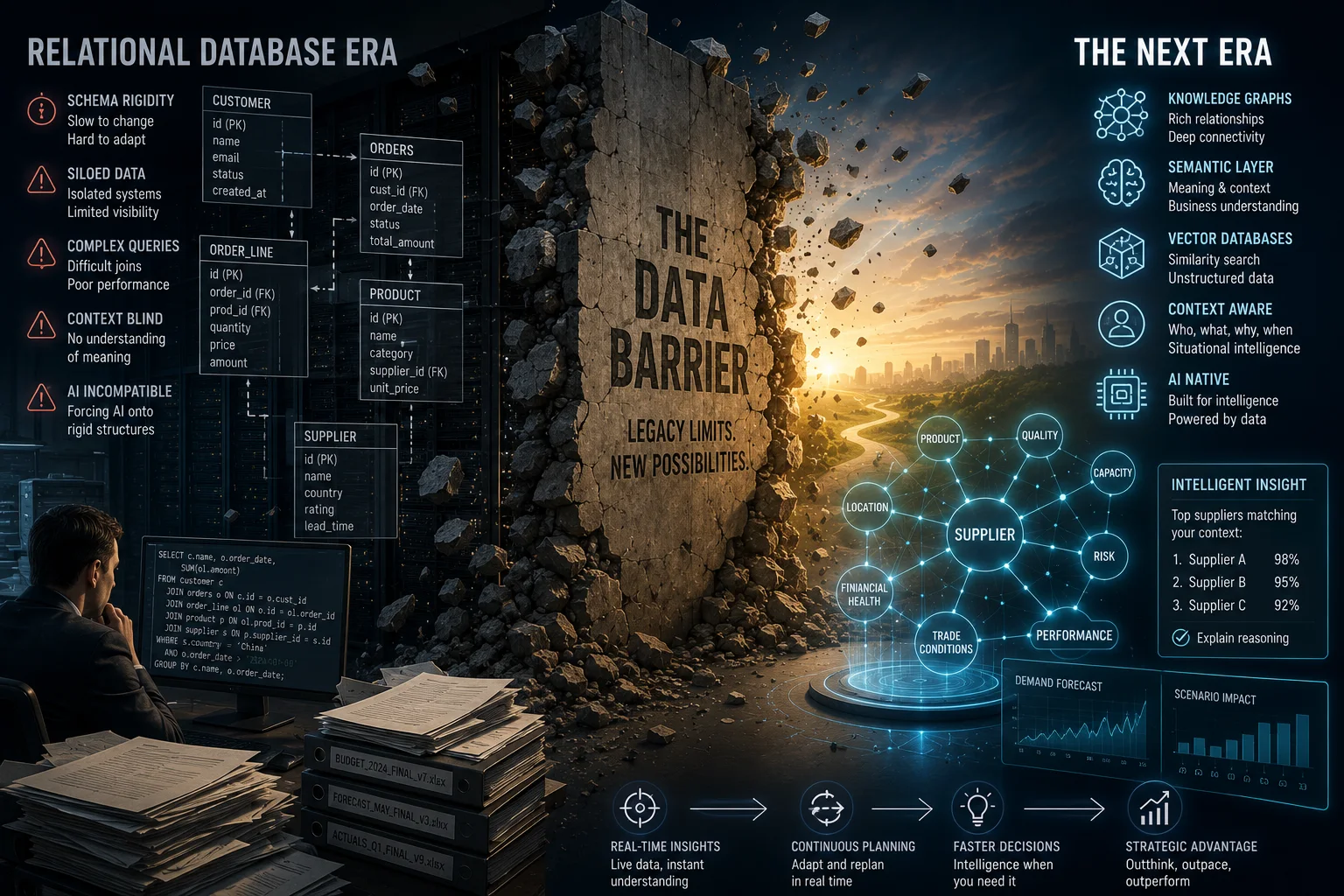
On this page
01The database that cannot answer the question
A supply chain team asks its ERP system a question that sounds simple: which suppliers have consistently delivered quality components on time, have the capacity to scale with our growth, and operate in regions with favorable trade conditions?
The system cannot answer it. Not because the data is missing — it is all there, scattered across supplier tables, purchase orders, quality inspections, delivery records, and an external trade database. The problem is that the schema holds the facts without holding the relationships, the meaning, or the reasoning the question actually requires.
So an analyst spends three days writing SQL, joining dozens of tables, and correlating data by hand across systems. By the time the analysis is finished, the business context has moved and three new questions have replaced the original one.
This plays out thousands of times a day in enterprises worldwide. The relational database management systems that have powered enterprise software for forty years are meeting their structural limits. They were brilliant for structured transactional data — recording orders, tracking inventory, managing accounts. They are a poor foundation for the context-aware, semantically rich intelligence that modern business now expects from the same systems.
What follows is why RDBMS is reaching that limit, the cost organizations are already paying to work around it, and the architecture that is replacing it — knowledge graphs, semantic layers, vector databases, and context-aware design.
02The brilliance and the limits of relational databases
Why the relational model was revolutionary
To understand why enterprises are moving past relational databases, it is worth being precise about why they won in the first place.
Before RDBMS, data management was chaotic. Applications kept their own files in proprietary formats. Querying required writing a program. Redundancy was rampant and consistency was close to unachievable. Edgar Codd’s relational model, published in 1970, resolved all of it at once: data organized into tables of rows and columns, relationships defined through foreign keys, a declarative language for querying, and ACID properties guaranteeing transactional integrity.
For structured transactional data the fit is still excellent. Recording an order means writing rows into customer, order, and order line tables. Retrieving a customer’s orders is a join. Keeping the result consistent is what transactions are for. The relational model remains the right answer for four things.
- Structured data that fits a predefined schema with fixed columns and types.
- High-volume, low-latency transactional workloads with strong consistency requirements.
- Queries that join related tables along known foreign key paths.
- Scenarios that demand strict referential integrity and ACID guarantees.
None of that is in question. The problem is that a growing share of what the business now asks of its systems falls outside those four cases.
Where the model breaks down
- Schema rigidity
- Adding an attribute means a schema change, and schema changes lock tables and disrupt operations. Where data structures evolve weekly, a predefined schema becomes a straitjacket.
- Relationship complexity
- One-to-many and many-to-many are handled well. "Find every supplier connected to this product through any path of relationships" requires recursive queries that perform badly or are not expressible at all.
- Semantic poverty
- A relational database stores data but not meaning. A customer table holds customer records; the system has no representation of what a customer is, how customers relate to other concepts, or which operations on them are valid.
- Context blindness
- The same query returns the same result regardless of who is asking, why, or what they are trying to accomplish. Every piece of context-aware behavior has to be built in application code above the database.
- AI incompatibility
- Machine learning and language models need relationships, context, and semantics. The database supplies none of the three, which forces organizations to extract data, transform it heavily, and stand up separate AI infrastructure alongside the system of record.
Enterprise resource planning systems manage assets in relational databases, contrasting with the potential of knowledge graphs. The current field of artificial intelligence for knowledge suggests a move beyond the single-path traversal limitations of relational databases.
03The chaos tax: what it costs to force AI onto RDBMS
Organizations layering AI onto relational systems pay a chaos tax — the money, time, and complexity spent making two incompatible architectures cooperate. It is rarely a line item, which is exactly why it grows unchallenged. It has six components.
- Extraction and transformation
- AI needs data in shapes the relational store does not hold it in, so pipelines are built to extract, reshape, and load it elsewhere. Those pipelines are fragile, expensive to maintain, and add latency to everything downstream.
- Semantic layer construction
- Because the database does not capture meaning, someone has to define what the data means, how concepts relate, and which operations are valid. That knowledge currently lives in application code, documentation, and the heads of long-serving staff. Reconstructing it is the single most expensive part of the work.
- Context management
- Context-aware behavior requires knowing user roles, business processes, organizational hierarchy, and situational factors. None of that is in the schema, so a parallel context store gets built to hold it.
- Integration complexity
- The AI systems have to talk to the transactional systems. Built on incompatible foundations, that conversation needs middleware, API layers, and synchronization machinery — each with its own failure modes.
- Dual maintenance
- Two systems now exist: the relational core for transactions and something else for intelligence. Schema changes propagate. Data synchronizes. Business logic is implemented twice and diverges quietly.
- Performance overhead
- Moving and reshaping data costs time. Real-time intelligence is not achievable when the data has to be extracted, transformed, and loaded before anyone can ask a question of it.
What it looks like from the business side
- Time to insight — questions that should take seconds take hours or days, so the answer arrives after the decision.
- Failed AI initiatives — projects are abandoned not because the AI did not work but because preparing the data for it cost more than the result was worth.
- Competitive lag — organizations with modern architecture ship AI capabilities in weeks; organizations without one measure the same work in quarters.
- Constrained innovation — the ideas that get proposed are the ones the architecture can accommodate, which is a quieter and more serious cost than any of the above.
- Talent loss — capable data scientists and AI engineers do not want to spend their careers maintaining extraction pipelines, and they have options.
04The new paradigm: knowledge graphs and semantic architecture
What a knowledge graph actually is
A knowledge graph models the world as entities and the relationships between them, rather than as tables of rows and columns. Five things make up the model.
- Entities
- Real-world concepts — customers, products, suppliers, orders, locations — represented as nodes.
- Relationships
- The connections between them — customer purchased product, supplier located in region, product contains component — represented as edges, and queryable in their own right.
- Properties
- Attributes of both entities and relationships: a customer name, a product price, the date a supplier relationship began.
- Semantics
- Formal definitions of what the entities and relationships mean, captured in ontologies that specify concepts, properties, and constraints.
- Context
- Information about the data itself — who created it, when, why, under what conditions — held as first-class metadata rather than convention.
Why the model suits AI and the relational one does not
- Semantic richness — the graph carries meaning alongside data, so a system can reason about what an entity represents and which operations apply to it.
- Relationship traversal — following relationships through arbitrary paths is the native operation, not an expensive recursive query bolted onto a join engine.
- Context awareness — context is stored rather than inferred, so behavior can legitimately differ by who is asking and why.
- Flexible schema — new entity types and relationships are additions rather than migrations, which is what lets the model keep pace with the business.
- Inference — if supplier A supplies component B, and component B is used in product C, the system can derive that supplier A is relevant to product C without anyone writing that query.
- Natural language fit — graphs align with how people describe their business, which makes them a far better substrate for conversational interfaces than a normalized schema.
Enterprise knowledge graphs, buttressed by semantic technology standards like ontologies, RDF graphs, and taxonomies, are useful applications of graph database technology. They provide opportunities for contemporary enterprises when used alongside modern developments in artificial intelligence.
Where organizations are using them
- Customer, supplier, and product 360 views that unify data from across the enterprise into one relationship-rich representation.
- Search that understands meaning and context, returning the right result when the query does not match the stored terminology.
- Recommendations built on relationship patterns rather than on co-occurrence counts alone.
- Fraud detection through network analysis — rings of related accounts and transaction patterns that are invisible row by row.
- Supply chain intelligence: which suppliers are genuinely critical, where the concentration risks are, and how a disruption propagates.
- Regulatory tracking of which rules apply to which products in which jurisdictions, where the answer is a path through relationships rather than a field.
05Vector databases and semantic search
Traditional database search is keyword matching. Search for "supplier quality" and the system returns records containing those words. That fails in four ordinary situations: the user does not know the terminology the database uses, the relevant record uses a synonym, the meaning depends on context rather than wording, or the user wants conceptually similar results instead of exact matches.
How vector search works
- 01An embedding model converts text, images, or other content into high-dimensional vectors, such that semantically similar content produces similar vectors.
- 02The vectors are stored in a database optimized for similarity search rather than exact lookup.
- 03A user query is converted into a vector by the same model, and the database returns the nearest ones — relevant results whether or not the words match.
- 04Hybrid retrieval combines vector similarity with keyword search and graph traversal, which in practice outperforms any one of the three alone.
That fourth step is the one worth planning for. Pure vector search retrieves things that are thematically close but sometimes factually irrelevant; keyword search retrieves exact matches and misses everything phrased differently. Production systems almost always end up combining them.
What it enables
- Document search that works
- "Show me contracts with unusual liability clauses" returns the right contracts even though none of them contain that phrase.
- Conversational interfaces
- Natural language front ends that interpret intent and retrieve the relevant material from enterprise systems rather than requiring the user to know where it lives.
- Anomaly detection
- Identifying records that sit semantically far from the normal pattern, which catches the unusual case that no rule was written for.
- Similarity-based recommendation
- Suggesting products, suppliers, or next actions based on resemblance to past outcomes that worked.
06Context layering
Context layering is the practice of capturing the information that gives data meaning, rather than storing the data in isolation and reconstructing the context later. It answers six questions about every material fact in the enterprise.
- Who
- Who created this, who has accessed it, and who is authorized to use it. User context.
- What
- What it represents, what its properties mean, and which operations on it are valid. Semantic context.
- When
- When it was created, when it changed, and the period over which it is valid. Temporal context.
- Where
- Where it originated, where it is stored, and where it is consumed. System and spatial context.
- Why
- Which business process produced it and what purpose it serves. Process context.
- How
- How it was derived, what transformations were applied, and how much confidence its accuracy deserves. Lineage and quality context.
What that makes possible
- Access control decided on context rather than role alone — what the user is trying to do, why, and under what circumstances.
- Automation that adapts: routine transactions processed automatically, unusual ones escalated because the system can tell the difference.
- AI that can explain a decision by pointing at the context it considered, which is the difference between a usable recommendation and an unauditable one.
- Compliance evidence that covers not just what data exists but how it was created, used, and protected.
- Data quality assessed against purpose, since a record adequate for one use is often inadequate for another.
What it requires architecturally
- Semantic metadata that records meaning, not only technical attributes such as type and length.
- Provenance tracking across the full lineage — origin, transformations, and every system that touched the record.
- Temporal modeling that preserves how things were at a point in time, not only how they are now.
- Explicit modeling of the relationships between data, processes, users, and systems.
- Interfaces that return contextual information alongside the data, so consumers do not have to guess at it.
07Retrieval-augmented generation: bridging AI and enterprise data
Retrieval-augmented generation is the pattern that made enterprise language model deployment practical. Rather than training a custom model on enterprise data — expensive, slow, and stale on arrival — RAG retrieves the relevant material at question time and supplies it to a general-purpose model as context. Five steps, in order.
- 01A user asks a question in natural language.
- 02The system searches knowledge graphs, vector indexes, and conventional databases for material relevant to it.
- 03What it finds is assembled into the context supplied to the language model.
- 04The model generates an answer grounded in that context rather than in its training data alone.
- 05The answer carries citations back to the source records, so it can be verified rather than trusted.
Why this pattern changed enterprise AI
- No custom training
- General-purpose models are used with enterprise data as context, which removes the largest cost and the longest lead time from the project.
- Always current
- A trained model is a snapshot. Retrieval reads the systems as they are now, so the answer reflects this morning’s data.
- Explainable
- Every response traces to source documents. In a regulated function, an answer that cannot be traced cannot be used, however good it is.
- Secure by construction
- Sensitive data stays in the systems that already govern it, and retrieval returns only what the asking user is entitled to see.
- Scalable
- Adding data means indexing it, not retraining anything, which is what makes the approach viable across an enterprise rather than one department.
What it looks like inside ERP and EPM
- Conversational ERP: "what is our inventory position for product X" answered directly, instead of navigated to through four screens.
- Reporting by description — the user says what they want to know and the system assembles the report, rather than the user learning the report builder.
- Process guidance for new users, answered from the organization’s own documented procedures instead of from memory or a colleague’s interruption.
- Decision support where an executive asks a strategic question and gets analysis drawn from across the enterprise data estate.
Generative AI integrates with structured enterprise systems like ERP via retrieval-augmented generation and knowledge graphs. Orchestration pipelines facilitate this integration, enabling intelligent, conversational, and context-aware workflows.
08The autonomous enterprise
Knowledge graphs, semantic architecture, vector retrieval, and language models converge on something enterprise software has not been before: systems that participate in operations rather than only recording them. In practice that means five capabilities, in roughly the order organizations acquire them.
- 01Intelligent process automation — the system recognizes a situation, understands the process, and executes the appropriate action.
- 02Predictive operations — issues are identified before they occur and preventive action is taken.
- 03Adaptive workflow — work routes itself according to complexity, urgency, and available expertise rather than a static rule table.
- 04Autonomous decisions on routine matters, with complex or unusual cases escalated deliberately rather than by exception handling.
- 05Continuous learning from outcomes, so the system’s judgment improves instead of merely persisting.
Agentic AI in enterprise systems
Agents are the current frontier: software that perceives its environment, decides, and acts toward an objective. Four patterns are being deployed in enterprise settings today.
- Supply chain agents
- Monitoring conditions, predicting disruption, and adjusting procurement, production, and logistics within defined authority.
- Financial agents
- Watching performance, identifying anomalies, and either recommending or executing the corrective action depending on how much latitude they are given.
- Service agents
- Understanding a customer issue, gathering the relevant information across systems, and resolving it end to end.
- Compliance agents
- Monitoring operations for compliance exposure and either correcting it or escalating with the evidence attached.
Agentic AI systems integrate into ERP software to enable more intelligent, adaptive, and efficient business processes. These systems offer independent strategic development, instantaneous execution, and autonomous recovery from operational interruptions.
What holds it up
- A knowledge graph foundation that captures entities, relationships, and semantics comprehensively enough to reason over.
- Ontology-based reasoning, so the system infers rather than only retrieves.
- Federated AI, distributing capability across the enterprise and learning collectively without centralizing sensitive data.
- Explainability as a design requirement rather than a later addition — every autonomous decision needs a defensible account of itself.
- Human oversight placed deliberately: autonomy for routine cases, escalation for the rest, and a clear line between them that the business owns.
09What organizations must do now
Assess where you actually are
The assessment is uncomfortable, which is why it tends to be skipped. Four questions establish the current state honestly.
- How much of the enterprise data estate is locked inside rigid relational schemas?
- What is the chaos tax in real terms — how much engineering effort goes into extracting and reshaping data for AI each year?
- How context-aware are the current systems, in the specific sense of behaving differently based on who is asking and why?
- What semantic understanding exists anywhere in the architecture, as opposed to in application code and institutional memory?
Then the gap analysis: which capabilities does the business need that the current architecture cannot support, where are competitors gaining ground with a different foundation, and which AI initiatives have already failed for architectural reasons rather than technical ones. That last question usually produces the business case on its own.
A four-phase transformation
- Phase 1 — foundation (months 1 to 6)
- A knowledge graph pilot on one well-chosen use case such as customer 360 or supply chain intelligence, the beginnings of a semantic layer for the key entities, a vector database behind a semantic search pilot, and deliberate skills development for the teams who will own it.
- Phase 2 — expansion (months 7 to 18)
- Extend the graph to further domains, implement retrieval-augmented generation for conversational access to enterprise data, begin capturing contextual metadata as a matter of course, and build the integration architecture that lets the relational core and the graph coexist.
- Phase 3 — intelligence (months 19 to 36)
- Integrate AI across the enterprise systems, deploy agents against specific processes, adopt federated learning where privacy requires it, and hold every AI capability to an explainability standard before it goes live.
- Phase 4 — transformation (month 37 onward)
- Migrate gradually from a relational-centric to a graph-centric architecture, widen autonomous operation, and establish a standing process for adopting capability rather than a series of projects.
The timeline is not padding. Architectural transformation of this kind takes years, and the organizations that compress it into a single program are the ones that end up with a pilot nobody extended.
Critical success factors
- Executive vision
- A clear picture of the future state and a commitment that survives the first budget cycle. This work does not produce a demonstrable win in one quarter.
- Incremental value
- Value delivered through pilots and phases. A big-bang architectural replacement has the same failure profile as a big-bang ERP replacement, for the same reasons.
- Skills investment
- Real investment in graph modeling, semantic technology, and AI integration capability. These are not adjacent skills to relational data engineering.
- Change management
- Attention to process, role, and culture, not only to technology. Systems that participate in decisions change what the people around them are accountable for.
- Vendor partnership
- Partners who understand the architectural shift rather than partners selling a product that happens to be adjacent to it.
- Patience
- Sustained commitment across years. The organizations that succeed treat this as a direction of travel, not a project with an end date.
10The architectural imperative
The relational database era is ending — not because relational databases are bad, but because they remain excellent at exactly the thing they were designed for while enterprise requirements have moved elsewhere. Context-aware, semantically rich, AI-powered intelligence needs a different foundation, and no amount of pipeline engineering substitutes for it.
The chaos tax is the argument. It is being paid already, invisibly, in engineering time and abandoned initiatives, and it grows with every AI capability bolted onto a schema that cannot support one. The organizations that move deliberately — one domain, one semantic layer, one pilot worth extending — will end the decade with systems that can answer the question the supply chain team asked at the top of this article. The ones that do not will still be writing the three-day query.
None of this argues for ripping out the system of record. The transactional core stays where it is, doing what it does well. What changes is that it stops being the only place the enterprise keeps its knowledge.
The question is not whether to transform the data architecture. It is how quickly the first domain can begin.