Under the hood: the technical realities of ERP implementation
The problems that keep IT leaders awake at night are rarely the software. They are data migration, integration debt, customization, sizing, and testing — the layers under the hood where programs actually break.
By OneVision Consulting
Share on LinkedIn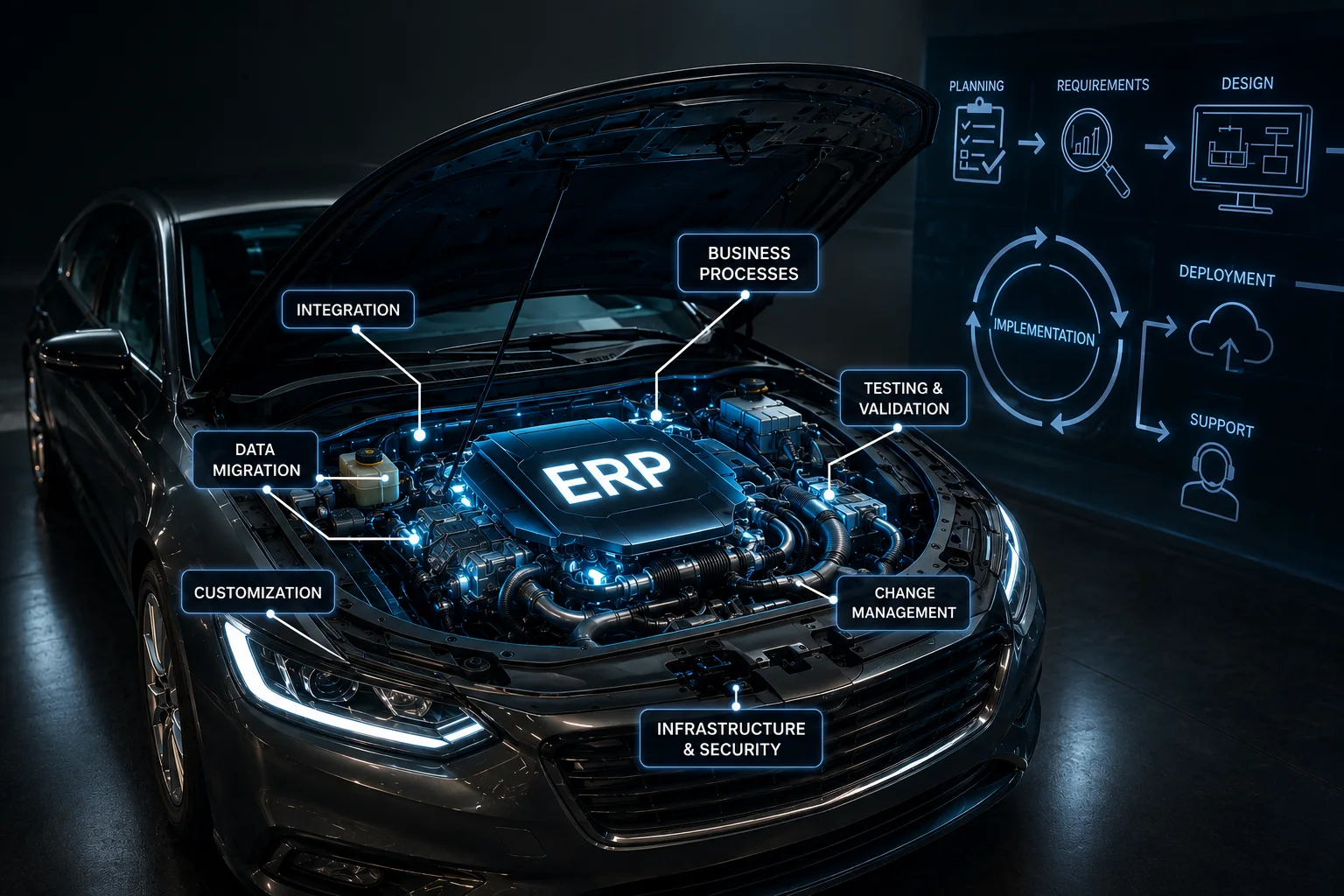
On this page
01The 3 a.m. phone call
It is 3 a.m., and the CIO’s phone is ringing. The ERP cutover that was supposed to be routine has hit a critical issue. The data migration script that worked perfectly in testing is failing in production. Customer orders are stuck in limbo between the legacy system and the new ERP. The warehouse cannot process shipments. Revenue is bleeding by the minute.
This scenario plays out in organizations worldwide — not because of poor planning or incompetent teams, but because ERP implementation presents technical challenges of extraordinary complexity. The integration of disparate systems, the migration of decades of data, the reconciliation of conflicting business logic, and the orchestration of cutover across global operations create a perfect storm of technical risk.
For many IT leaders, ERP implementation is the most technically demanding project of their career. Unlike greenfield development or a straightforward system replacement, ERP touches every technical layer of the organization: databases, middleware, networks, security, applications, and integrations. A failure in any layer can cascade through the entire system.
What follows is a technical deep-dive into the realities of ERP implementation — the architectural challenges, the data complexities, the integration nightmares, and the emerging technologies that define modern enterprise systems. It is written for IT leaders who need to understand not just what can go wrong, but why, and what to do about it.
02The data migration crisis: where most projects fail
The illusion of clean data
Every ERP implementation begins with an optimistic assumption: "our data is pretty clean." That assumption is almost always wrong, and discovering the truth mid-project is where implementations derail.
Organizations accumulate decades of data in legacy systems, each with its own data model, validation rules, and quality standards. Customer records exist in multiple systems with conflicting information. Product hierarchies differ between manufacturing and finance. Vendor data includes duplicates, obsolete entries, and inconsistent naming conventions. Data that seemed good enough for operational use proves catastrophically inadequate for migration.
Research consistently identifies data quality as a critical challenge in ERP implementation. Poor data quality propagates errors throughout the integrated system, undermining the value of the entire investment — yet organizations systematically underestimate the effort required for cleansing, reconciliation, and migration.
The technical challenges compound quickly:
- Schema mapping complexity
- Legacy systems and ERP platforms use fundamentally different data models. Mapping between them is not a field-to-field translation — it requires understanding business logic, handling missing data, resolving conflicts, and maintaining referential integrity across millions of records.
- Data transformation logic
- Beyond mapping, data usually requires transformation. Date formats must be standardized. Codes must be translated. Hierarchies must be restructured. Business rules embedded in legacy applications must be extracted and reimplemented. Each transformation introduces the risk of corruption or logic errors.
- Volume and performance
- Migrating millions or billions of records inside a cutover window requires real performance work. Scripts that run fine against a few thousand test records fail catastrophically at production volume, where database locks, network bandwidth, and system resources become the binding constraints.
- Referential integrity
- ERP systems enforce referential integrity that legacy systems may have ignored. Orders reference customers, customers reference addresses, addresses reference geographic hierarchies. A single missing or invalid reference can cause failures that cascade through every dependent record.
- Historical data decisions
- How much history should be migrated? Full history provides continuity but increases complexity and risk. Selective history reduces risk but leaves gaps in reporting and analytics. Either way, the decision has long-term implications for business intelligence and regulatory compliance.
Poor data quality propagating throughout the integrated ERP system creates ongoing operational costs and decision-making risks. Organizations struggle with data accuracy, data conversion from legacy systems, and ensuring data quality throughout the implementation process.
The data quality investment nobody makes
Successful data migration requires investment that organizations consistently underestimate:
- Data profiling and assessment
- Systematic analysis of legacy data to understand quality issues, identify patterns, and quantify cleansing requirements. This belongs early in the project, not during migration execution.
- A data cleansing strategy
- Automated cleansing where possible, manual remediation where necessary, and explicit rules for edge cases and exceptions — balanced against the timeline the program actually has.
- Master data management
- Authoritative sources for customers, products, vendors, and employees, plus the processes that keep them clean after go-live. MDM is often treated as a post-implementation concern when it should be foundational.
- Migration testing
- Multiple iterations against production-like volumes, with validation of business logic and verification of referential integrity. Testing against small data sets produces false confidence.
- Rollback planning
- Documented procedures for rolling back a failed migration: database snapshots, transaction logs, and stated recovery time objectives. Hope is not a rollback strategy.
03Integration nightmares: when systems will not talk
The legacy integration challenge
Modern enterprises run on dozens or hundreds of systems: ERP, CRM, MES, WMS, PLM, HR, e-commerce, and countless specialized applications. ERP implementation means integrating with that ecosystem, and every integration is a potential point of failure.
Legacy systems were never designed for integration. They use proprietary protocols, undocumented APIs, and batch-oriented architectures. Documentation is incomplete or nonexistent. The developers who built them left years ago. Yet business operations depend on them, and they must keep functioning during and after implementation.
Each integration pattern carries its own failure mode:
- Point-to-point
- The simplest approach becomes unmaintainable fastest. With N systems you need N(N-1)/2 integrations, each custom-built, fragile, and hard to monitor. A change in one system ripples through everything connected to it.
- Enterprise service bus
- An ESB provides a central hub and reduces point-to-point sprawl, but introduces performance bottlenecks, a single point of failure, and a need for specialist expertise. ESB implementations can become as complex as the problem they were bought to solve.
- API-based integration
- Modern REST APIs give the cleanest pattern, but legacy systems often have no API to call. Building wrappers around them requires deep understanding of their internal logic and data structures.
- Batch integration
- Many legacy systems support only scheduled file transfers. That creates latency in synchronization and complicates error handling, and real-time business processes struggle inside batch constraints.
API sprawl and integration debt
As organizations add systems and capabilities, integration complexity compounds. Each new system needs integrating with several existing ones. Integration logic becomes distributed across the enterprise, making dependencies hard to see, issues hard to troubleshoot, and changes hard to make.
- Maintenance burden
- Every custom integration needs ongoing maintenance as systems evolve. API changes, security updates, and business logic modifications all ripple through the integration layer.
- Performance degradation
- Synchronous integrations create cascading delays; asynchronous ones complicate error handling and data consistency. As complexity grows, performance suffers either way.
- Monitoring challenges
- Understanding the health of dozens of integrations requires real monitoring. When something breaks, diagnosing root cause across multiple systems and layers is extraordinarily difficult.
- Change resistance
- "We cannot modify that process because it would mean changing fifteen integrations" becomes a common refrain. Fragile integration layers turn into strategic inflexibility.
04Customization: the technical debt that never stops growing
The customization trap
Every ERP implementation faces the customization question: adapt the business process to fit the system, or customize the system to fit the process? The answer has profound technical implications.
Organizations customize for legitimate reasons — a unique process that provides genuine competitive advantage, a regulatory requirement specific to their industry, integration with a proprietary system. The business case often looks compelling.
The technical reality is less forgiving:
- Implementation complexity
- Custom code has to be designed, developed, tested, and integrated with standard functionality. Interactions between customizations and standard features produce unexpected behavior that is difficult to diagnose.
- Testing burden
- Customizations require testing of the custom functionality and of its interactions with everything standard. Regression testing grows harder as customizations accumulate, and coverage that looked adequate proves insufficient when edge cases surface in production.
- Upgrade complexity
- Upgrades are where customization costs truly land: re-implementing custom logic, testing compatibility with new versions, sometimes redesigning around changed standard features. Organizations discover that a customization costing $100,000 to build costs $500,000 to maintain across upgrade cycles.
- Performance impact
- Custom code is rarely as optimized as vendor-provided functionality. Poorly designed customizations create bottlenecks, database locks, and scalability limits that only appear under production load.
- Knowledge concentration
- Customizations create dependencies on the specific people who understand them. When those people leave, the organization inherits risk it cannot see.
Excessive customization, particularly package code modification, complicates maintenance and necessitates re-implementation during upgrades. Each customization increases implementation costs, complicates testing, and makes future upgrades exponentially more expensive.
A customization decision framework
Disciplined IT leaders make customization decisions systematically rather than case by case:
- The competitive advantage test
- Does this process provide genuine competitive advantage, or is it just how it has always been done? If it is not a differentiator, adopt the standard process.
- The regulatory test
- Is the customization required for compliance, or is it a preference? Regulatory requirements justify custom work; preferences do not.
- Configuration before customization
- Can the requirement be met through configuration instead of code? Configuration is vastly preferable — it is vendor-supported, survives upgrades, and creates no technical debt.
- Total cost of ownership
- What is the lifetime cost, including development, testing, maintenance, and upgrades? Often the TCO of a customization exceeds the cost of adapting the process.
- Vendor roadmap alignment
- Is this functionality already on the vendor roadmap? If it is, waiting for the standard feature usually beats building your own.
05Security and compliance: the non-negotiables
The expanding attack surface
ERP implementations dramatically expand the attack surface. Systems that were isolated become interconnected. Data that was siloed becomes integrated. Access that was controlled by physical security becomes network-accessible.
- Transition vulnerabilities
- During implementation, controls are often relaxed to facilitate testing and migration. Test environments hold production data without production security. Temporary access granted to implementation teams quietly becomes permanent.
- Integration security
- Every integration point is a potential vulnerability. APIs must be secured, authentication must be robust, data in transit must be encrypted — and legacy systems frequently lack the capability to do any of it well.
- Access control complexity
- ERP requires sophisticated role-based access control. Defining roles, assigning permissions, and maintaining least privilege across a complex org structure is genuinely hard, so organizations default to permissive access to avoid operational friction.
- Data privacy
- ERP consolidates personal data from across the organization, creating obligations under GDPR, CCPA, and similar regimes. Data residency, consent management, and the right to erasure all have to be implemented technically, not just documented.
Compliance in the cloud era
Cloud-based ERP adds a further set of questions:
- Data sovereignty
- Where is data physically stored? Does it cross international borders? Do the cloud provider’s terms satisfy the regulations you are held to?
- Audit trails
- Compliance requires comprehensive trails of data access and modification. Cloud systems have to provide audit capability that meets the standard, not merely logging.
- Disaster recovery
- Regulations often mandate specific recovery time and recovery point objectives. The architecture has to be designed to meet them, and tested against them.
- Vendor security
- You remain responsible for compliance even when the platform is someone else’s. Vendor security practices, certifications, and incident response capability need real evaluation.
06Infrastructure and performance: sizing for reality
The performance sizing challenge
ERP systems have to perform under real conditions: thousands of concurrent users, millions of transactions a day, complex queries against billions of records. Sizing for that while controlling cost takes analysis, not a vendor worksheet.
- Underestimating concurrency
- A test environment with dozens of users says nothing about behavior with thousands. Concurrency creates database contention, network congestion, and application server bottlenecks that testing never surfaced.
- Ignoring peak loads
- Average load is irrelevant. Month-end close, seasonal demand, and year-end processing create patterns that dwarf average utilization — and those are the days the system must not fail.
- Neglecting growth
- Infrastructure sized for today becomes inadequate as the organization grows. Three to five years of headroom is the right target, even though forecasting growth is difficult.
- Database performance
- The database is usually the limiting factor. Poorly designed queries, missing indexes, and undersized database servers create bottlenecks that are painful to resolve after go-live.
- Network bandwidth
- Global deployments need adequate bandwidth between sites. Latency invisible in single-site testing becomes a production issue the moment a remote plant starts transacting.
Cloud, on-premise, or hybrid
The architecture decision has technical consequences either way:
- Cloud advantages
- Scalability, far less infrastructure management, faster deployment, and access to cloud-native capabilities like analytics and AI.
- Cloud challenges
- Data sovereignty concerns, dependency on connectivity, narrower customization options, and ongoing subscription cost.
- On-premise advantages
- Complete control of infrastructure, data, and security; the ability to customize extensively; predictable long-term cost.
- On-premise challenges
- Significant capital investment, a permanent maintenance burden, slower deployment, and difficulty scaling.
- Hybrid approaches
- Many organizations keep sensitive data on-premise while using cloud services for analytics, collaboration, and elastic capacity. Hybrid buys flexibility at the price of two operating models.
07Testing strategy: where confidence comes from
Why testing fails
ERP testing is where theory meets reality, and reality usually wins. Programs that economize on testing pay for it in production failures, data corruption, and operational disruption.
- Inadequate coverage
- Testing concentrates on happy paths while edge cases, error conditions, and integration failures go untested. Production then reveals scenarios nobody considered.
- Unrealistic test data
- Sanitized, simplified data sets give false confidence. Production data contains the edge cases, invalid values, and tangled relationships that break things.
- Insufficient volume testing
- Performance testing at small volume reveals nothing about production. Load testing needs production-scale data and realistic concurrency to be worth running.
- Integration testing gaps
- Unit testing individual components gives no assurance the integrated whole works. Integration testing is often superficial and misses the complex interaction scenarios.
- User acceptance theater
- UAT becomes a checkbox exercise when users lack the time, training, or motivation to test properly. The issues that should have been caught there emerge in the first week live.
The testing strategy that works
Successful implementations invest heavily and deliberately in testing:
- Test environment fidelity
- Environments that mirror production in data volume, configuration, and integration complexity. Shortcuts here manufacture false confidence.
- Automated regression testing
- Suites that can be re-run cheaply as the system changes. Manual testing cannot keep up with the complexity and change velocity of an ERP program.
- Performance and load testing
- Systematic testing under realistic load, including peak periods and stress scenarios, with problems resolved before go-live rather than triaged after it.
- Integration testing
- Every integration point exercised, including error conditions, timeouts, and data consistency validation.
- Structured user acceptance testing
- Clear scenarios, trained users, and enough time to test properly. UAT should validate business processes, not just system functionality.
- Cutover rehearsal
- A full dress rehearsal of cutover — data migration, configuration, and rollback included. Cutover night should hold no surprises.
08The emerging role of AI and ML in modern ERP
From transactional to intelligent
The next generation of ERP is different in kind from its predecessors. Machine learning is turning systems of record into platforms that predict and recommend, which changes both what they can do and what it takes to implement them.
- Predictive analytics
- Models that forecast demand, identify risk, and project outcomes from historical patterns and real-time data.
- Intelligent automation
- AI-assisted handling of routine work — invoice processing, expense approval, data entry — reducing manual effort and error rates.
- Natural language interfaces
- Conversational access to ERP data, which changes who in the business can get an answer without asking IT for a report.
- Anomaly detection
- Algorithms that flag unusual transaction patterns for investigation, catching fraud, error, and process deviation earlier.
- Recommendation engines
- Systems that suggest the next best action from context, history, and business rules — vendors, pricing, process changes.
The architecture that AI requires
Getting there requires architectural evolution, not a feature flag:
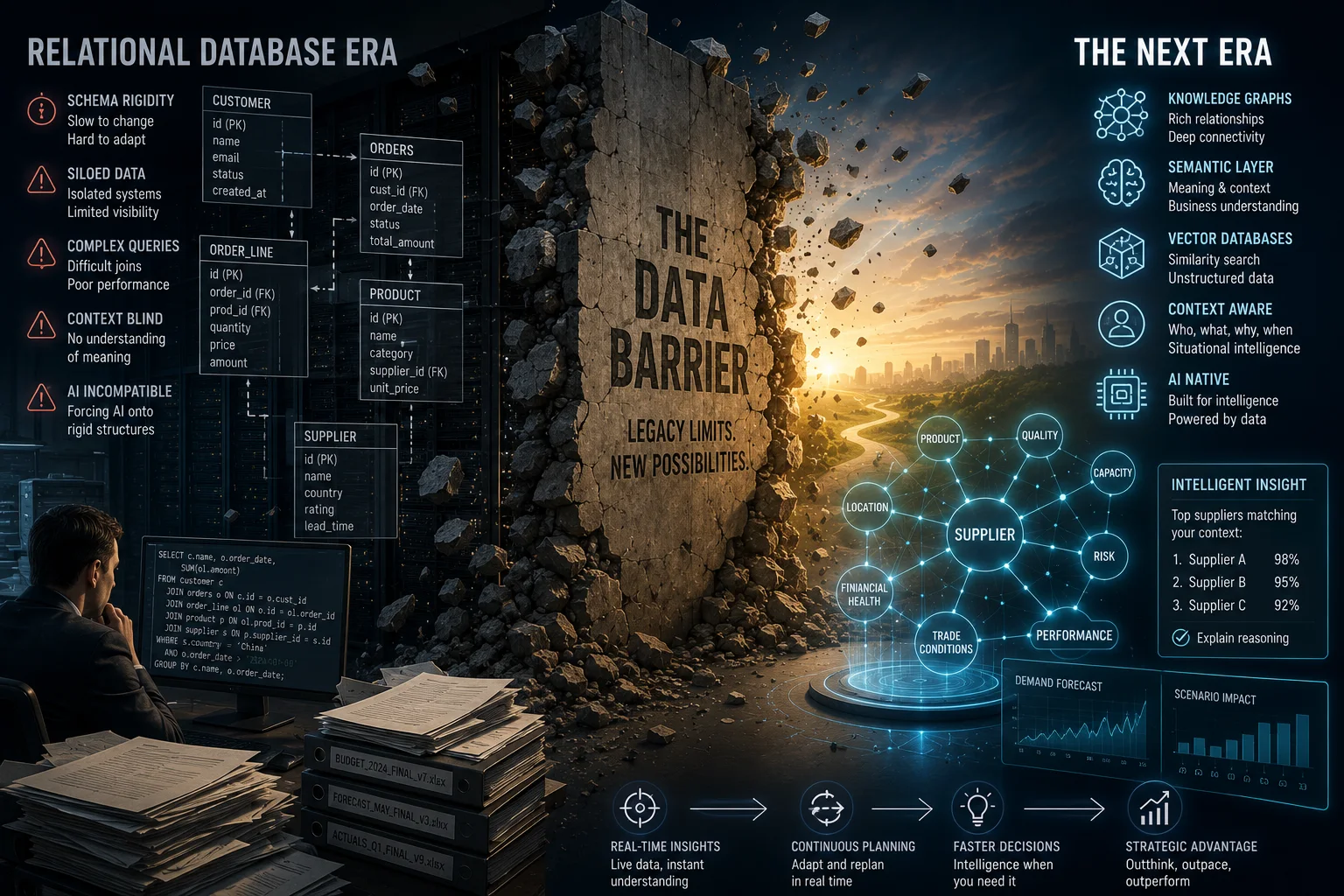
- Knowledge graphs
- Moving beyond rigid relational schemas to structures that capture semantic relationships and support contextual reasoning.
- Semantic layers
- Adding meaning to ERP data so AI systems can interpret context rather than merely process structured records.
- Retrieval-augmented generation
- Combining language models with enterprise data so answers are grounded in organizational knowledge instead of generated from nothing.
- Federated learning
- Training across distributed data sources while preserving privacy, enabling AI capability without centralizing sensitive data.
- Explainable AI
- Ensuring AI-driven decisions can be explained and audited — a hard requirement for regulatory compliance and for user trust.
Generative AI integrates with structured enterprise systems like ERP via retrieval-augmented generation and knowledge graphs. Orchestration pipelines facilitate this integration, enabling intelligent, conversational, and context-aware workflows.
What that means for implementation
- Data quality requirements rise
- AI is only as good as the data behind it. Quality problems that were tolerable in a transactional system become disqualifying in a predictive one.
- Computational requirements rise
- AI and ML workloads need real compute, particularly for training models and processing large data sets.
- New skills are required
- Implementing and running AI-enabled ERP calls for data science, machine learning engineering, and AI operations alongside traditional functional and technical roles.
- Governance is not optional
- These systems make decisions that affect people and business outcomes. Frameworks for AI ethics, bias detection, and decision transparency have to exist before go-live, not after an incident.
09Technical excellence as competitive advantage
ERP implementation presents technical challenges of extraordinary complexity: data migration crises, integration nightmares, customization debt, security and compliance obligations, infrastructure sizing, testing strategy, and now the added complexity of AI-enabled systems.
For IT leaders, those challenges are both risk and opportunity. Programs that approach them with technical rigor — investing in data quality, designing robust integration architectures, making disciplined customization decisions, implementing security properly, sizing infrastructure realistically, and testing thoroughly — are the programs that go live and deliver.
The emerging generation of AI-enabled, knowledge-graph-powered ERP offers capabilities the previous generation could not, and introduces complexities it never had. Leaders who understand those technologies well enough to architect around them will create durable advantage for their organizations.
Technical excellence in ERP implementation is not just about avoiding failure. It is about building the intelligent, adaptive enterprise systems that define competitive advantage from here on.