The hidden business cost of ERP implementation: what no one tells the C-suite
Software, hardware, and implementation services are 30 to 40 percent of what an ERP program costs. The rest — lost productivity, change management, data quality, customization debt, and support — is where business cases quietly come apart.
By OneVision Consulting
Share on LinkedIn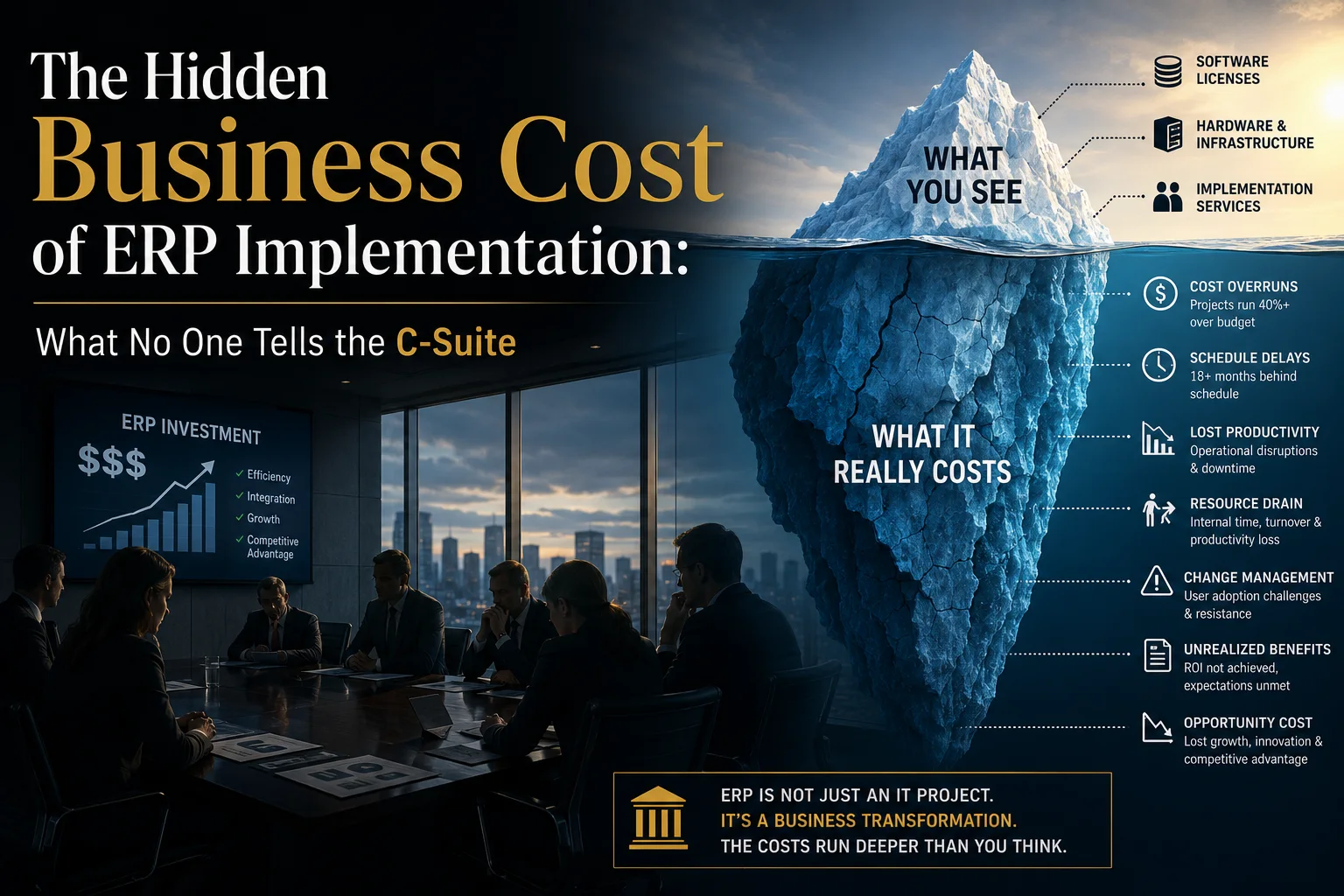
On this page
01The $10 million question nobody asks
In boardrooms everywhere, executives approve multi-million-dollar ERP implementations with confidence. The business case looks solid: streamlined operations, integrated data, better decisions. The vendor presentations are polished. The ROI projections are compelling. The contract gets signed.
Then reality arrives.
Three years later the same executives face a sobering picture. The project is 40 percent over budget and eighteen months behind schedule. The promised benefits remain out of reach. Key people have left. Operational disruption has cost millions in lost revenue. The board is asking hard questions, and one of them is about the CEO.
That scenario is not an outlier. Research across industries and geographies puts the share of ERP implementations that fail to meet their stated objectives at 50 to 75 percent, with fewer than 10 percent considered fully successful against their original goals. Organizations keep underestimating the true business cost of these programs — scrutinizing software licensing and hardware while leaving the strategic, financial, and organizational risks that actually decide the outcome out of the conversation.
What follows is the part vendors do not present and consultants often soften: where the money really goes, when the benefits really arrive, and what a board should demand to know before it signs.
02Why most ERP projects fail
The failure rate that never makes the business case
Start with the elephant in the boardroom: most ERP implementations fail. Not “encounter challenges” or “experience delays” — they fundamentally fail to deliver the business value that justified the investment.
The numbers are damning. Measured against their original objectives, fewer than 10 percent of ERP projects are considered successful. The majority experience significant cost overruns, schedule delays, and delivered functionality that does not meet the business need. Many organizations discover too late that the system they spent millions implementing does not support the way they actually work.
The high failure rate of ERP projects — fewer than 10 percent successful — combined with significant cost and schedule overruns, is one of the most persistent problems in enterprise technology.
Why does that rate persist after decades of collective implementation experience? Because organizations underestimate the complexity of changing everything at once, misjudge scope, and fail to plan for the organizational transformation the software assumes. They run ERP as a technology project when it is a business transformation.
Betting the company on a single roll
For many organizations an ERP implementation is existential risk. It touches every business process, every department, and every employee. When one fails it does not merely embarrass IT — it can cripple operations, damage customer relationships, and cost the organization its competitive position.
- Operational disruption
- During implementation and cutover, transaction processing slows, data becomes temporarily inaccessible, and people struggle with unfamiliar systems. That translates directly into lost revenue, missed customer commitments, and damaged relationships.
- Diverted attention
- While an organization is consumed by its own ERP problems, competitors keep innovating and taking share. The opportunity cost of the executive attention, organizational energy, and capital pulled into a troubled program is rarely counted anywhere.
- Strategic inflexibility
- ERP systems impose their own logic on strategy and culture. Organizations that do not recognize this find themselves unable to pursue initiatives because “the system cannot support it.” The platform becomes a straitjacket rather than an enabler.
- Reputation risk
- Failed implementations become public knowledge. Suppliers, customers, and investors notice when a company struggles with basic operations, and that damage outlasts the technical fixes.
03The cost of doing nothing
Faced with those risks, some executives consider the alternative: keep the legacy systems and avoid the program altogether. That is rarely a viable long-term strategy, because standing still carries its own price.
- Integration complexity
- Every new capability bolted onto legacy infrastructure is another custom, fragile, expensive-to-maintain connection. The integration tax compounds with each one.
- Talent drain
- Skilled people do not want to work on obsolete technology. Knowledge of the old platform concentrates in a few aging experts, which is key-person risk in its purest form.
- A widening competitive gap
- Competitors on modern platforms respond faster to market changes, serve customers better, and run leaner. The gap widens each year and can eventually become impossible to close.
- Compliance exposure
- Legacy systems often lack the controls, audit trails, and reporting that modern regulation assumes. As the rules evolve, the cost and risk of staying compliant on an old platform escalate.
So the real question is not whether to modernize. It is how to do it without becoming one of the statistics.
04The hidden costs that destroy business cases
Beyond software licenses
Most ERP business cases account for the direct costs: licensing, hardware, and implementation services. Those typically represent 30 to 40 percent of total cost of ownership. The remainder — the costs usually left out — is where programs hemorrhage money.
- Organizational disruption
- Productivity typically drops 20 to 40 percent during implementation as people learn new systems and processes. For an organization with $500 million in revenue, that can mean $50 to $100 million in foregone revenue or added cost. Few business cases carry the line at all.
- Change management
- Organizations commonly allocate 5 to 10 percent of the project budget to change management where the evidence supports 20 to 30 percent. The shortfall reappears later as resistance, low adoption, and benefits that never materialize.
- Data migration and quality
- Migration is the single most underestimated workstream. Legacy data turns out to be incomplete, inconsistent, or incompatible, and cleansing and reconciliation can cost more than the software. Bad data that survives the move keeps costing money in every decision made from it.
- Customization debt
- Customizing the system to preserve existing processes creates technical debt that compounds. Each change raises implementation cost, complicates testing, and makes every future upgrade more expensive. Over a decade that carry can dwarf the original build.
- Post-implementation support
- Running and supporting the system typically costs 15 to 25 percent of the original implementation cost every year — a permanent line item that belongs in the business case rather than arriving as a surprise in year two.
When the benefits actually arrive
Even successful implementations rarely deliver quick returns. The realistic shape of the curve looks like this.
- Year one
- Net negative. Implementation spend peaks, productivity drops through cutover, and disruption hits revenue. Most organizations are 20 to 30 percent over budget by go-live.
- Year two
- Continued investment. Stabilization, further training, and process refinement keep consuming resources. Early efficiency gains are largely offset by ongoing cost.
- Year three
- Break-even at the earliest. Users become proficient, processes settle, the system gets optimized, and cumulative benefit can finally match cumulative cost.
- Years four to seven
- Positive return. This is where the efficiency, decision quality, and lower operating cost promised in the original business case start to show up.
- Year eight and beyond
- The upgrade cycle. Major upgrades land every five to eight years, and the investment curve begins again.
That timeline assumes the implementation succeeds. Failed programs never reach positive return, and troubled ones push break-even out by years.
Companies often neglect post-implementation requirements, especially maintenance and support, which compromises the usefulness and operation of the ERP. Poor planning of those services can imperil normal operations and daily business activities.
05Executive sponsorship: where leadership fails
The CEO who delegates disaster
One of the most consistent predictors of ERP failure is inadequate executive sponsorship, and it is where most implementations begin to come apart.
The pattern is familiar. The CEO approves the project, delegates execution to the CIO or CFO, and returns attention to more strategic matters. The program proceeds without visible executive engagement. When the hard problems arrive, and they always do, the team has no authority to decide, no way to resolve cross-functional conflict, and no route to the resources it needs.
- Resource allocation
- These programs need the organization’s best people, which means taking them off revenue-generating work. Without a sponsor, business units decline to release them and the team gets whoever was available instead of whoever was needed.
- Conflict resolution
- Implementation forces genuinely hard decisions about process standardization, organizational structure, and who gives ground. Those can only be settled at the executive level. Left unsettled, they fester and the program loses momentum.
- Organizational commitment
- Employees read leadership. When executives visibly prioritize the program, the organization follows. When they are absent or ambivalent, people conclude it does not really matter and behave accordingly.
- Strategic alignment
- The system has to serve the strategy rather than constrain it, and keeping it pointed that way takes continuing executive involvement. Otherwise technical considerations quietly become the decision criteria.
The steering committee that does not steer
Many organizations stand up a steering committee and then design the authority out of it. The recurring failures:
- Insufficient authority — members cannot settle anything without escalating it.
- Inadequate frequency — quarterly meetings for a program that needs decisions weekly.
- Wrong representation — technical experts dominate while business leaders are absent or disengaged.
- No accountability — decisions get made but not enforced, commitments made but not tracked.
An effective committee is senior people with real decision rights, meeting often enough to keep momentum, with named accountability for the decisions they make.
06Change management: the investment nobody makes
Change management is named as a critical success factor in study after study. It is also, reliably, the first thing cut. Most organizations fund it at 5 to 10 percent of the project when the research points to 20 to 30 percent, and the gap is not abstract.
- User resistance
- People who do not understand why the change is happening, or what it does for them, resist it — in workarounds, shadow spreadsheets, and compliance that is technically met and practically absent.
- Low adoption
- Even without active resistance, thin training and support produce minimal use of an expensive system. The capability is installed; the benefit never lands.
- Productivity loss
- The dip during implementation is unavoidable, but its depth and duration track change management quality directly. Well-supported organizations fall less far and recover faster.
- Benefits that never appear
- The ultimate cost. The system goes in but the processes do not change, data gets entered but not used, and integration is achieved technically while the organizational silos stand.
What adequate change management looks like
- Regular, candid communication from senior leadership about why the change is necessary and how it serves the strategy.
- Systematic stakeholder engagement that surfaces concerns early and addresses resistance rather than waiting for it.
- Role-based training in the new way of working, not just in which buttons to press.
- A change agent network with the standing to support peers and flag problems while they are still small.
- Explicit adoption and benefit metrics, reported and acted on like any other operational measure.
07Vendor selection: the million-dollar mistake
The RFP that guarantees the wrong answer
Most organizations select an ERP vendor through a formal RFP that systematically excludes the things that matter while scoring the things that do not.
The typical RFP asks vendors to answer hundreds of functional requirements, often inherited from a template or a previous procurement. Vendors respond with answers engineered to score well and reveal little. The organization picks the highest score, then discovers during implementation that critical capabilities are missing, need expensive customization, or do not work the way the demonstration suggested.
- Checklist thinking
- Exhaustive requirement lists with no distinction between critical and nice-to-have. Vendors claim capabilities that exist in theory, or only after significant custom work.
- Ignoring methodology
- The vendor’s implementation approach and delivery track record matter more than the feature grid. Most selections weigh the software and ignore the ability to land it.
- Organizational fit
- Every ERP embodies assumptions about how a business should run. The fit between those assumptions and your processes and culture is a cost driver, and it is rarely assessed.
- Total cost of ownership
- Initial licensing is a fraction of the total. Maintenance, upgrade complexity, and the cost of the customizations you already know you will want belong in the comparison.
- Reference checking
- Vendor-supplied references are curated. Independent conversations with organizations of similar size and complexity are where the useful information is.
A business case that survives contact
- Strategic alignment
- Which specific objectives does this investment serve, and what becomes possible that is impossible today?
- Organizational readiness
- Does the organization have the leadership commitment, change capability, and cultural tolerance this requires — now, not in principle?
- Risk assessment
- What are the specific risks to this program, how will each be mitigated, and does the total sit inside the organization’s risk appetite?
- Honest costing
- Are the indirect and ongoing costs in the number? Productivity impact, change management, and post-implementation support should be included and funded.
- Benefit realization
- How exactly will each benefit be realized, who owns it, and how will progress be measured and reported?
- Alternatives
- What does a phased approach, a best-of-breed strategy, or continued investment in the current platform look like by comparison?
08What the programs that work do differently
The statistics are sobering but not deterministic. Organizations do implement ERP successfully, and the research is consistent about what separates them.
- Visible, sustained sponsorship from the CEO and the leadership team — for the whole program, not the kickoff.
- Change management funded as a business-critical workstream rather than a communications afterthought.
- Objectives stated as business outcomes instead of as “implement ERP.”
- Scope and timeline built from an honest assessment of complexity, and resistance to dates set for their own sake.
- Governance with real decision rights and named accountability for outcomes.
- Process design treated as the center of the work, because this is a business transformation with software in it.
- The organization’s best people assigned, with backfill for the jobs they are leaving.
- Data quality addressed early, with a migration strategy and ongoing governance.
- Customization decided deliberately, case by case, against the cost of carrying it.
- Maintenance, support, and continuous improvement resourced before go-live rather than after the first outage.
Ten questions every CEO should ask
- 01What specific business outcomes will this investment enable, and how will we measure them?
- 02What is our honest assessment of organizational readiness for this change?
- 03Do we have the executive commitment to see this through, including my own involvement?
- 04What is the total cost of ownership, including the hidden costs and post-implementation support?
- 05What is the realistic timeline to benefit realization, and can we sustain the investment that long?
- 06What are the top five risks to this program, and how will we mitigate each one?
- 07Do we have the right people available, or will we compromise with whoever is free?
- 08What is our change management strategy, and is it funded at the level the evidence supports?
- 09How will we keep the business running through implementation and cutover?
- 10What is the plan for post-implementation support and continuous improvement?
If the program team cannot answer those convincingly, the program is not ready to start.
09The conversation the C-suite must have
ERP implementation is one of the largest investments, and one of the largest risks, an organization takes on. The hidden costs — disruption, change management, data quality, customization debt, and the permanent cost of support — routinely exceed the visible cost of software and services.
The failure rate is not inevitable. Organizations that treat the program as a business transformation, fund sponsorship and change management properly, size scope and timeline honestly, and plan for life after go-live do beat the odds. That takes candid conversations in the C-suite about cost, risk, and readiness; executives who stay engaged instead of delegating; and boards willing to ask hard questions and insist on real answers.
The question is not whether your organization can afford to implement ERP. It is whether you can afford to do it wrong.